Mathematics, mathematicians, philosophy

Recently I was asked to talk at a secondary school about mathematics and mathematical philosophy. The following is roughly based on what I talked about…

I was asked to come and talk to you about mathematics, which is lucky, because I’m a mathematician. But then I wondered what exactly I should tell you.

I thought — well, should I give you a maths class? But I figure that’s probably not the best idea. I might talk about a little bit of actual maths, but don’t worry, there will be no test.

Then I thought — should I try to persuade you to study more maths? A sales pitch for mathematics? Well, I’m sure you’ve all had an excellent education here, in mathematics as in every other subject, so there’s no need for further persuasion. And anyway I’m not much of a salesman. However, I might try to show you a couple of things about maths that I think makes it interesting

Then I thought — should I tell you about all the places maths is useful in everyday life? Well, maths does come up pretty much everywhere, and it’s used by people all the time – sometimes with good effect, sometimes bad, but in any case it’s everywhere. So I might talk a little about that too. And It raises all sorts of big philosophical questions.

And speaking of philosophy — in the philosophy of mathematics there are all sorts of deep, abstract, and interesting questions there. Pretty heavy ones too. What does it mean for a mathematics to be true? What is mathematics anyway? Well, those are pretty deep questions, but since I’m the only professional mathematician in the room, I might say a little about it.

Then I thought — I’m just here to talk to you. And as far as I’m concerned I’m talking to adults.

But then I thought — oh, I should probably introduce myself first! Well it would be rude not to, so OK, I’ll do that first, then I’ll tell you some of the things I think about mathematics, which are hopefully kind of interesting. And then we’ll leave some time for questions, and you can ask me about anything you like.

* * *

So yes, I will start by telling you a little bit about myself. I’m a mathematician, a lecturer at Monash Uni. I’m also, a sometime lawyer, activist, writer, husband, dog owner.

I’ve been into maths since I was very young. At school I enjoyed learning lots of things, including mathematics and science. I’ve always wanted to know how the world works. But actually my favourite subject at school was history. You know, “maths, science, history – unravelling the mystery”. I heard that on TV somewhere. I enjoyed history: learning about how we came to be how we are now – how we got into this mess!

At school I found out I was apparently good at maths, and I got involved in the Maths Olympiad. I actually represented the country at the International Maths Olympiad.

I graduated from school, feeling like I didn’t know anything, and that there was so much more to learn. I went to university. I wanted to learn everything, but they only let me enrol in two degrees. So I studied science and law: the rules that govern the world, and the rules that govern society. And from then on I’ve never really left university, but I still feel like I know nothing. I did a few courses here in Melbourne, then I did a PhD in maths at Stanford University in California. I got involved in some politics as well  – I was involved in a website you might have heard of called Wikileaks, although I left it long ago, before it became famous, or rather, infamous. After getting my PhD I then worked in France, at the University of Nantes – Nantes is a city in north-western France which has good mathematicians and good crepes. Then I worked in Boston, at a university called Boston College. So as you can see mathematics is very international. It’s the same with all science really – it’s a very international enterprise.

I now work at Monash Uni, in the maths department there. I am also a fully qualified lawyer, and although I’ve never practised law, I have done volunteer legal work and been involved in some politics here as well. I’m an advisor, for instance, to a wonderful group called the Initiative for Equality, which works to build more equal and participatory societies around the world.

But that’s enough about myself. If you want to know anything more you will have to ask.

* * *

So, let’s get down to talking a bit about mathematics. And I thought a first thing to do might be to actually ask – what is mathematics? Because I suspect the average person, and you, and me, might all have different answers.

As a mathematician, I think it’s actually quite a difficult thing to define.

Perhaps the main thing I want to impress upon you about what mathematics is, is just how big it is, how long it’s been going, and how narrow a slice of it most people see. Maths is a lot more than the subject you learn at school called maths!

Studying maths at school, you can kind of get the impression that you study year 7 maths, and then year 8 maths, and so on, and finally you get to year 12 maths, and you are then done. You finished mathematics.

Well, no. At that point you know a little bit of the mathematics that was known up to the 17th century. You’ve seen essentially zero mathematics from the last 300 years – possibly a little bit, if you’ve got good teachers, as I’m sure you do here.

But what would your education be like, if you graduated from school completing all the English units, but never having studied, let alone read or even seen, any literature from after 1700? Well with mathematics it’s like that.

Perhaps it’s not quite that bad. Mathematics doesn’t change like English does. Literature from 1700 is now outdated, in a certain sense, but mathematics from 1700 is not. It’s just as true, just as valid now as it was then. And mathematics had made a significant amount of progress by 1700, so it’s not terribly bad that you only get up to 1700.

But it’s useful to place it in context. Mathematics has an enormously long and rich history, and its story goes right back to the beginning of civilization. We have evidence of writing numbers dating from about 3500 BC. The Sumerians were doing their times tables from 2500 BC. The ancient Egyptians knew about prime numbers before 1800 BC.

But mathematics exploded in ancient Greece from the 6th century BC onwards and took the world by storm. And since then, mathematics has been actively advancing.

Told you I liked history.

But whenever you are learning mathematics, you are tapping into one of the deepest continuous strains of human thought, and you are tapping into some of the most ingenious, clever, ideas ever conceived, ideas developed by some of the greatest minds in history.

Think of it this way. We are now so advanced that, in a mere 12 or 13 years of schooling, you’re able to go from a pre-literate level of mathematical understanding, up to the 17th century. That’s quite an achievement. It took humanity millennia, but for you it’s just exercises in your textbook – combined with good teachers.

So maths has been around a long time. It’s not going away – sorry if you don’t like it. It was here before we were born, it will still be here after we are gone. It will even survive Donald Trump. And it will be no less true for that.

* * *

So, what is mathematics? In the end I can’t really define it, but I can say some things that are mathematics and some things that are not.

Now, there are many things we know that are definitely included in mathematics. Algebra is maths. Geometry is maths. Anything with numbers in it is maths. Anything with exact logic in it is maths – maths has a type of thinking and a type of logic that is characteristic to the subject, and unlike the sort of thinking you get pretty much anywhere else – we might talk more about that later.

Some other things are definitely not mathematics. History is not maths. Biology, chemistry, physics are not maths, although they may use it. Physics is an interesting one actually – it’s very mathematical, and so much so that sometimes the boundary between physics and mathematics is unclear. I might talk more about that later.

The other sciences are easier to define than maths. You can say at least roughly what these other sciences are about. Physics is about the study of objects in the universe and so on, chemistry is about the properties of atoms and molecules and their reactions and so on.

The other sciences are easier to define because they’re basically limited to things which actually exist in this universe. Maths, on the other hand, has no such limitations. It does have some limitations. It shouldn’t be wrong. Two and two is definitely not five. Other than that, it’s limited only by our imagination.

* * *

Let me try to give you an idea of what I think mathematics is by giving you an example of the type of outlook a mathematician has.

Suppose a mathematician walks into a bar. This is not a joke… much…

In the bar there is a pool table. But as you’re all underage, you don’t know this.

(Source)

For those of you who haven’t played pool, the idea is to hit these billiard balls into the pockets using a cue stick. The exact rules aren’t important here, the point here is simply that the balls roll around on the table, bounce off the sides, hit each other, and so on.

Anyway, a lot of mathematics has been inspired by pool tables. And this is not (just) because mathematicians drink too much.

A mathematician might look at a pool table and see some interesting geometry problems – to get this ball into that pocket, where should you aim? Well perhaps you can do a reflection like this, and aim over there.

(Source)

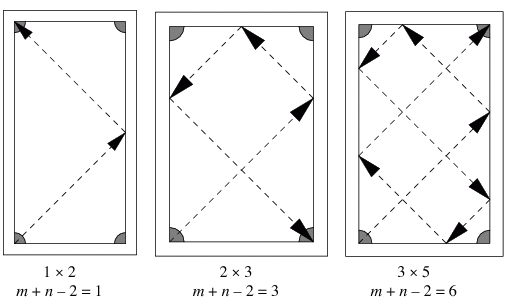
And she might go further, and wonder, what can you say about the path, the trajectory traced out by a billiard ball? Is it possible for a ball to start off in one position, going in a particular direction, and later come back to that position going in the same direction? Can it do so after hitting every wall? Is it possible to hit the wall 17 times and come back to your initial position and direction? Is it possible for a billiard ball to go in such a way that it eventually passes through every point on the table?
(Source)

What if you change the geometry of the table – make it a triangle, or a square, or a pentagon, or even make it curved? What if it’s a concave heptagon?

(Source)

What if it’s 3-dimensional?

(Source)

So, by pure imagination, you have a dozen questions all ready to think about. They belong to different fields of mathematics, some of which you may never have seen. But somehow they’re all mathematical questions. Some of them are much harder than others. Some might require more advanced ideas, or ideas that haven’t even been invented yet. Others might be impossible.

But the point I’m making is that mathematician is free to ask whatever questions she pleases. She is limited only by her imagination. She invents her own problems, and tries to solve them. She solves the ones she likes. She solves the ones she can.

In the meantime, everyone else in the bar is having a slightly less nerdy good time.

But in fact, it goes even further. There are several whole fields of mathematics devoted to billiard balls.

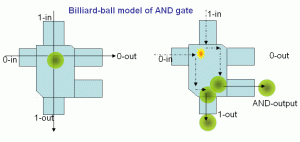
For example, mathematicians have shown that you can arrange billiard tables and billiard balls in all sorts of interesting shapes and configurations to get all sorts of interesting results. You could have many billiard tables, joined up by narrow passages, like pipes or tubes, forming patterns. You can have billiard tables designed to keep billiard balls rolling about for a while and then come out through a tube. You can have billiard tables with incoming and outcoming tubes, and a billiard ball comes out this tube if balls comes in both those tubes.
(Source)

Here is a picture of a billiard table which functions as an AND gate, which is something you see in electronic circuits and in computers. In fact, you can make computers out of billiard balls.

Of course, it’s a hypothetical computer where we assume that all the billiard balls move without friction and never slow down and don’t spin and so on. But mathematicians are happy to make those assumptions, we are not limited by those kinds of practical considerations. But under those assumptions, you can arrange a billiard table to do the things a computer can. Here’s the Wikipedia article on it.

And here is a book on mathematical billiards.

Here’s its table of contents.

Do you recognise any of the maths there? I’m struggling, and I do this stuff for a living!

It gets into some of the most advanced and cutting-edge areas of mathematics.

And this is just one sub-sub-sub field of contemporary mathematics. Mathematicians take an idea, like a billiard table, think up some problems, solve them, and develop entire theories out of their pure imagination and curiosity.

So maybe some mathematicians have too much time on their hands.

But who knows? Perhaps this mathematics one day will be used to design solar panels – after all that’s all about reflecting light rays cleverly, just like a pool player bounces balls off walls cleverly. Or who knows what else. Or perhaps not. History is full of examples of mathematicians thinking up maths for its own sake, which then later on turns out to be useful in a completely unforeseeable kind of way.

If their maths gets used for something useful, the mathematicians who invented it will be very happy; but, if it doesn’t, they won’t be particularly disappointed.

That’s how mathematics works. It is, by far, the craziest and most unpredictable of the sciences, and I think the most fun and the most profound.

* * *

It’s interesting, for instance, to consider from this point of view a subject that by now most of you – maybe all of you? –have studied: calculus.

Who discovered calculus? These two gentlemen.

(Source: Wikipedia x 2)

Calculus was discovered at roughly the same time by two different people: Isaac Newton (left), and Gottfried Wilhelm Leibniz (right). Newton was English, Leibniz was German, and who came first was a matter of national pride and a lot of controversy.

Online there is a comic called XKCD. It has nerdy maths jokes in it. Here’s one about the discovery of calculus.

(Source)

Get it? Because a derivative is a thing in calculus, but also, when someone takes an idea someone else has, it’s called…

Anyway, so let’s consider the discovery of calculus.

It is an enormous advance in knowledge to be able to use calculus. Using differential calculus, you can figure out, merely from knowing the position of an object, how fast it is moving, at any instant of time. You can then calculate the exact trajectory of an object – so you can work out the motions of objects, of any size, from billiard balls, to the motions of the stars, to… Angry Birds.

But the discovery of calculus was very controversial – not only for the priority dispute between Newton and Leibniz. It was also controversial because it made no sense. Do you remember your dy/dx, and wondering what the dx and the dy mean? The derivative dy/dx tells you how much y changes compared to how much x changes. But what is this dx and this dy? They are supposed to represent really small changes in x and y. But how small? Really small – infinitesimally small – smaller than any positive number – and yet not zero.

Newton and Leibniz both had incredible intuitions about these things. They knew what they were doing, and knew how to use calculus – and yet they couldn’t quite express their theories in a sufficiently rigorous way to satisfy their colleagues. They were mocked for producing these inconsistent things which were infinitesimally small and yet not quite zero and if not quite zero but not any definite number more than zero then what? Their colleagues asked WTF.

Later, the ideas of calculus were put on a logically firm footing – today it’s on firm ground. This was largely done with the idea of limits – and today, at school, when you learn calculus, you learn about it via limits. This definition of the derivative, which you’ve hopefully seen, comes much later – it was not how Newton or Leibniz did it.

But if you’ve ever felt that the dy and the dx are really weird and what the hell is going on here and am I really getting the full story – then I applaud your scepticism and you are in excellent company and you can get the full story with further study – although it’s not an easy story and there’s a reason it’s left to university. There’s a whole world of mathematics that comes from considering these ideas further — and that mathematics is crucial in engineering and physics and much more.

Newton invented calculus, actually, not out of pure curiosity, but because he wanted to understand the motion of the planets. It was physics that motivated him. And he made enormous breakthroughs by applying calculus to the problem.

Calculus is an intellectual superpower. And today, everyone who learns calculus receives the benefit of this superpower. You all have the power to calculate how fast something is going merely from knowing its position as a function of time. Tell us where something is, and we can tell you where it is going. Nobody had that power until 300 years ago, and today it has become completely routine. Although the awesomeness of your superpower may become a little lost on you as you differentiate six hundred slightly different functions from your mathematics textbook.

And of course, our mathematical superpowers have grown enormously since the 17th century.

We now know how to use mathematics to see how matter bends space and time. We use mathematical superpowers to move gigabytes of information in mere seconds around the world – and yet invisibly, so that all you see of it is a cat video.

We use mathematical superpowers to encrypt our messages so that even if we broadcast our encrypted message to the world, put it on display, and even broadcast how we encrypted it, then all the computing power in the world is not enough to decode our message.

Mathematics can do all this, and we are still figuring things out.

I like to think of mathematics as a brain extension. Mathematics is a brain extension that allows you to solve some problems you never thought you could. And it’s being developed further all the time.

* * *

And that leads to a philosophical question, which you may have discussed in your theory of knowledge course. What is mathematical knowledge? Whatever it is, it’s a different type of knowledge to almost anything else.

When we say that 1+1=2, we’d say that’s a true statement. It’s not very controversial. That’s mathematical knowledge.

But if we said that 1+1=3, we’d be pretty well justified in saying it’s false. That’s not very controversial either. That’s also mathematical knowledge, a known falsehood.

And this truth and falsehood is in a kind of absolute sense.

And there are of course many other mathematical truths. That’s what mathematics consists of. All the mathematical theorems and facts you’ve learned at school so far are mathematical truths.

So let’s look at one piece of mathematical knowledge, which is really nice: Pythagoras’ theorem.

Remember what Pythagoras’ theorem says?

Pythagoras’ Theorem:
In a right angled triangle, the square of the hypotenuse is equal to the sum of the squares of the other two sides.


(Source)

Yes, but can you prove it?

Actually there are many many ways to prove Pythagoras’ theorem. It’s probably the most proved theorem ever. There are books consisting entirely of hundreds of different proofs of Pythagoras’ theorem. I’ll show you one of my favourites, which is similar to a one given by Bhaskara, an Indian mathematician who lived in the 12th century AD.

It’s a proof by animated GIF.

(Source)

This animation I think shows really nicely what’s going on.  Now to give a proof you should write an actual argument, and explain why when you swing the triangles around they make the arrangement shown. But that’s not too hard. I think you can get a lot out of this picture.

But I think, if you understand this picture – and you might have to stare at it for a while to fully understand it – then you will understand that the certainty with which we believe Pythagoras’ theorem to be true is a similar level of certainty as we believe that 1+1=2.

So this is another example of a mathematical proof – a type of knowledge which is arguably the most certain thing in the world.

* * *

So 1+1=2, Pythagoras’ theorem, and other mathematical theorems, all have this kind of absolute truth about them. The level of knowledge contained in them is very different from other statements.

Are there any statements outside of mathematics which have a similar status of absolute truth?

Well, there are facts about the world, which are pretty certainly true. There is a chair here, today is sunny, Donald Trump is the President-Elect of the United States. The last one may be hard to believe, but that doesn’t make it any less true. They’re all empirical facts.

Still, I wouldn’t say they quite have the same level of certainty as 1+1=2. We might debate what sunny means, about the technicalities of US elections. And we might be wrong about them. We say it’s sunny, but this is Melbourne, so it might spontaneously cloud over and rain in a few minutes. Perhaps it will be discovered tomorrow that there was a giant conspiracy to rig the US election. There are also more radical ways we could be wrong. Perhaps there is not in fact a chair here and my eyes are deceiving me. Perhaps I am hallucinating. Perhaps we are all hallucinating. Perhaps this is all a dream. All these things are very unlikely, but in a certain sense, not entirely inconceivable.

On the other hand, is it ever possible that 1+1=2 could be falsified?

Scientific facts and theories also have a very high status as knowledge. But even scientific facts and theories are falsifiable. In fact, this is the whole point of scientific theories: they should be able to be confirmed or disproved. Even the most well-established theories can turn out to be wrong. Newton’s theory of gravity works to a very high level of precision, but turns out it’s wrong – it was superseded by Einstein’s theory of relativity, which makes different predictions, and when they differ Newton is wrong and Einstein is right. Relativity might be superseded in due course. Every scientific fact is just as weak as the next experiment, and if the next experiment doesn’t agree with the theory, it could all come tumbling down.

But could you imagine that one day an observation will contradict 1+1=2, and that in fact it might turn out to be a tiny bit more than 2? Not really. It’s an interesting question why, and nailing down the certainty of mathematics is a topic which has occupied some of the greatest minds in mathematics and philosophy – people like Descartes, Bertrand Russell, and Kurt Gödel.

So there’s a certain sense in which mathematics is the most certain type of knowledge. One might even define mathematics as the thing that produces certain knowledge.

But the type of knowledge that you get from mathematics is limited. It can tell you many things about numbers, or polynomials, or geometry, but perhaps not so much about, say, morality, or justice, or a good life, or love. Perhaps it might contribute something, but not much.

Actually my favourite nerd-comic, XKCD again, has a good one about mathematics and love.

(Source)

A mathematician has some tools that can be used to analyse many things. But alas, it doesn’t take you very far here. Although there is a recent book by Hannah Fry called “The Mathematics of Love”, which is lots of fun.


(Source)

* * *

A related question is about what type of thing mathematics is. When the ancient Greeks wrote down the first proofs of Pythagoras’ theorem, were they inventing it, or discovering it?

With science, we speak of scientific discovery, not invention. We discover the law of gravity, or the laws of optics, or whatever. We don’t invent it. The law was already there; humans just figured it out.

When we speak of invention, we mean something that is made by humans, created by human ingenuity. We invent the steam engine, the transistor, the iPhone, and so on. The invention wasn’t there before; humans brought it into being.

When mathematicians prove new theorems, is it like discovering the law of gravity, or inventing the iPhone?

A lot of mathematicians, in describing how they solve problems and prove theorems, will talk about discovery rather than invention. Pythagoras’ theorem was true before they proved it; they just found a proof.

In that case, mathematics already exists. As we gain more knowledge about it, we discover it, just like the laws of nature.

If you’ve ever solved a hard maths problem, you might have had a feeling that everything finally made sense, that it all became clear, you finally “saw” it. And that kind of feels like you were discovering something, or finally seeing something clearly that was already there. Often in maths we find that there is a nice answer that “really” explains what’s going on – perhaps like that proof of Pythagoras we saw before. And then we talk about “finding” or “discovering” the solution, rather than inventing it.

This sort of approach is often associated with the ancient Greek philosopher Plato – and called Platonism. Platonism is then basically the view that abstract objects exist. When we say that 1+1=2, what are we saying? It seems that we are saying that there are numbers, 1 and 2, and when we add the 1 to itself we get 2. But then what are these things called numbers? The Platonist says that, you know what they are, they exist and they are ideal objects. They are not objects you can touch, but they exist just as well. They are not just in our minds. If there were no humans in the universe, or anyone to think it, it would still be true that 1+1=2. So, a Platonist would say, the numbers 1 and 2 exist.

And similarly, the Platonist would say, not just 1 and 2, but every single number exists. They are all mathematical things. Similarly, abstract triangles, sets, functions and so on all exist. Every abstract mathematical object exists.

So, that’s one view, Platonism.

A contrary, anti-Platonist view, which sometimes goes by the name of nominalism, is that no, there is no heaven somewhere containing all these objects. Where would it begin and where would it stop? Mathematics can think up all manner of abstract objects, and if all of them exist, eternally and regardless of whether we think of them, then this is just an enormous parallel universe littered with mostly useless abstract objects, all adding very little except confusion.

Well, fair enough, but then the nominalist has to answer the question: If 1 and 2 are not things that exist, then what are they?

So, suppose you’re asked to explain why 1+1=2. What do you say?

If you’re a normal person, you might say something like, when I have one thing and I put it together with another thing I get two things. If you do this, it’s pretty much a nominalist point of view. You’re not arguing that the numbers are pre-existing things. On this view, numbers are just a sort of generalisation – an abstraction from everyday observations. We made the generalisation a long time ago, probably in our infancy, from collections of objects, to numbers. On this view, numbers are just these really cool abstract ideas, ideas in our heads, useful to count things.

If you’re not a normal person but a mathematician, and you’re asked to explain why 1+1=2, then you might start by answering like the normal person, but if you’re pressed on the point, you might take a different tack. You might fall back on definitions. You might go back to a definition of 1, and a definition of 2, and a definition of addition and equals, and then explain why, when you put all these definitions together and make a few deductions, you get an explanation as to why the statement 1+1=2 is true. So the whole thing becomes a big exercise in definitions, and you have to make sure of what your definitions are and why they all fit together – and in the end, the whole thing is just a tautology. 1+1 = 2 because we defined 1 and 2 and + and = in such a way that 1+1=2 is true. This approach sometimes goes by the name of formalism, because it relies on formal definitions.

Now this might seem bizarre. Is it really possible to define the number 1? Is it possible to define addition? Aren’t these just the basic concepts in mathematics? And also, don’t you have to define things in terms of simpler things? How far back can you go? How simple is simple enough? Where does it all end?

Well many mathematicians have thought about this, and there are mathematicians who have devoted a huge amount of time to building mathematics up from the simplest of foundations. In the early twentieth century, two mathematicians thought about it a lot.

(Sources: Bertrand Russell Society, Wikipedia)

These two guys are Bertrand Russell and Alfred North Whitehead. They were both leading mathematicians of the early 20th century. Russell was also a very famous philosopher and author and socialist and educator and peace activist and many other things – probably one of the most impressive human beings of the 20th century. He arguably literally saved the world during the Cuban Missile crisis in 1962, but that’s a whole other story.

These two mathematicians thought very long and hard about how to define mathematics from the very beginnings, from simple, obvious – even more obvious than 1+1=2 – propositions called axioms. And then to deduce the whole of mathematics from that.

They wrote an enormous series of books, 3 volumes, 2000 pages. It was called Principia Mathematica. There it is.

(Source)

And in these 2000 pages they make every single definition and axiom and deduction absolutely clear and explicit. And eventually, they manage, after 700 pages or so, to prove that 1+1=2. Here’s the key part of the proof.

Looks like alien hieroglyphics doesn’t it? But yes, after nearly a thousand pages, these mathematicians proved that 1+1=2.

Well you can now relax.

You might wonder if these guys had anything better to do. Well, actually Bertrand Russell as I mentioned had lot of things of other things to do as well, but he thought this was at least as important!

So, anyway, if you asked me to explain why 1+1=2, and pressed the point, I would eventually point you back to this work of Russell and Whitehead – Principia Mathematica.

And this is really the modern approach in mathematics. A mathematician these days will often write their proofs by making formal definitions of whatever she’s talking about, and then deducing things about them. These objects might or might not relate to the real world; sometimes they do, and sometimes they do not. When they do that’s great; when they don’t, it’s not a great disappointment.

And that is roughly my view. I’m not a Platonist, I’m a nominalist, and a pretty formalist one when it comes down to it. But there are plenty of mathematicians who are Platonists. When you solve a maths problem, I would say, it might feel like you’re uncovering something from the Platonic heaven of universal ideas, but if you feel that way, I’d say that’s just because mathematics is a wonderful subject.

* * *

OK, well that’s all pretty heavy stuff.

Let’s talk about some actual living mathematicians. Most people don’t know any mathematicians alive today, so let me introduce you to a few leading ones.

(Source)

This is Grigori Perelman. He won the Fields Medal in 2006. The Fields Medal is the maths equivalent of a Nobel Prize. He works in a field of mathematics not so far from my own. He is an interesting guy – friend of one of my PhD supervisors.

Anyway, Perelman solved one of the hardest outstanding problems about 3-dimensional space, called the Poincare conjecture, about 10 years ago. I’m not going to try to explain it to you here, but it’s a fundamental problem, but really hard, really fundamental, and there was actually a million dollar prize for anyone who could solve it. He solved it. He then got famous, was in the media a lot, and he didn’t like being paraded in the media. He decided that the community of mathematicians was corrupt, and turned down the million dollar prize. He currently, so far as I know, lives as a hermit with his mother in St Petersburg.

Mathematicians are often interesting characters.

Here’s another interesting character.

(Source)

This is Edward Witten. He is a physicist, perhaps most famous for his work on string theory. But he also won the Fields medal, in 1990, because in doing physics he also did a lot of mathematics. And it’s mathematics which people are still trying to figure out, myself included. Perhaps you can think of what he’s doing, as like Newton or Leibniz with calculus in the 17th century. I read his papers and I have no idea what he’s talking about. Some mathematicians think Witten is sloppy, and talking a lot of nonsense. But then when it comes down to mathematical statements, and calculations, you tend to find out that he’s right. It’s incredible intuition which somehow almost transcends mathematics. By all accounts he’s a very nice guy, and an absolute machine. Is what he does mathematics? It’s not the traditional way of doing mathematics, and not all mathematicians think it is, but I think it is. Just like calculus was hard to digest back in those days, some of Witten’s work isn’t quite yet digestible as maths.

Ed Witten actually studied history at university. He got a degree in history. Then he dropped out of that and decided he wanted to do… economics. Then he dropped out of that too and worked in…. politics. He worked on a losing campaign. They he turned to… maths, but dropped out of that too. Finally he turned to physics. And today he’s probably the most influential physicist alive.

And here’s another famous mathematician.

(Source)

This is Maryam Mirzkhani. She’s an Iranian mathematician, and another Fields Medallist. She works in a field, again, not so far from what I do. She is a great role model for women wanting to study science and mathematics.

* * *

Let me tell you about some of the things I do in my daily life as a mathematician.

As I said, I’m a lecturer at Monash Uni. So one thing I do is lecturing. I teach classes. I give lectures on mathematics. So if you come to Monash uni and study mathematics, you might be in one of my lectures. And if you go on to major in mathematics, you could take my course in differential geometry. If you go on to do honours in mathematics, I might end up teaching you topology. So that’s one thing I do, which is pretty good fun. At least it is for me! And for students, maybe, sometimes!

I also do mathematical research. I work in pure mathematics. As I’ve mentioned to you, as with the billiard balls, pure mathematical research is research that is done purely for its own intrinsic interest. It may have applications, or it may not; but we think it sufficiently interesting and important to develop new fundamental knowledge.

Mathematical research is like mathematical problem-solving, except you get to think up the problem as well as the answer. And if you solve a problem that nobody has ever solved, or even asked, before, then they have progressed human knowledge. And a lot of mathematics develops in this way.

So those are some of the things I do as a mathematician. But I’m not the only type of mathematician.

Many mathematicians also work on research which is much more applied. They tend to make a lot more progress than I do. They don’t beat their head against a wall with impossible problems like I do. Their research has direct practical applications and can affect people’s everyday lives.

Applied mathematics is often motivated by a concrete practical problem, and devising new practical solutions.

And there are many different types of applications. There are mathematicians who apply their mathematics to all sorts of things: chemistry, biology, data analysis, finance, transport, consulting, programming, economics, energy, engineering, government, health, insurance, meteorology, military, intelligence, logistics, biotechnology, teaching – of course, as your maths teachers do here – and much more. Maths is everywhere.

There are also many people who use maths as a large part of their job, but who may not actually call themselves “mathematicians”. They might be setting up mathematical models to simulate a practical situation. They might be making predictions based on such models. They might be running algorithms. They might be coding. They might be analysing data, or calculating statistics, or optimising a manufacturing process or transport network or energy flow. They’re all using maths to solve real world problems. Mathematical skills, and the creative logical thinking skills of mathematicians, are sought after by employers everywhere

So, maths is powerful. It can be used to do many things, and improve the power that we have to do things. It’s a superpower. Like all superpowers, it can be used to achieve all sorts of social ends, good or bad. It can be used to match up organ transplant recipients and save lives. It can be used in war to produce more efficient death. It can be used to optimise a transport network for maximum efficiency. It can also be used to optimise a coal mine for maximum extraction. It can be used to locate tumours and treat cancers. It can also be used to build bigger and more lethal weapons. It can be used to create a more equitable economic system. It can also be used to crash Wall Street.

It’s a big powerful thing, and like all science it can be used for all sorts of ends. I hope you enjoy it, and that you’ll put it to good use.

What to do while Rome burns

When the Goths sacked Rome, St. Augustine wrote the “City of God”, putting a spiritual hope in place of the material reality that had been destroyed. Throughout the centuries that followed St. Augustine’s hope lived and gave life, while Rome sank to a village of hovels. For us too it is necessary to create a new hope, to build up by our thought a better world than the one which is hurling itself into ruin. Because the times are bad, more is required of us than would be required in normal times. Only a supreme fire of thought and spirit can save future generations from the death that has befallen the generation which we knew and loved.

— Bertrand Russell, Principles of Social Reconstruction (1916)

The Eighteenth Brumaire of Donald Trump

Marx and Hegel remark upon the repeating phases of history. On the Eighteenth Brumaire (9 November) 1799, Napoleon Bonaparte seized power in France. Louis Napoleon did the same in 1851, and Marx wrote about the farcical character of the repetition. First as tragedy, then as farce, he said. Tragedy and farce and much more — with vastly greater consequences — have taken place on the Eighteenth Brumaire 2016.

History’s repetitions are not as cleanly tragedy then farce as Marx claims, but it does repeat, and it repeats each time with more tragedy and more farce. And economic development brings with each repetition more powerful technology, more powerful institutions, and greater means to inflict damage on the world.

It is surely true, as Marx wrote then, that people make their own history — voters vote for who they do with an intentional conscious choice — but they do not make it under self-selected circumstances. The circumstances are given and transmitted from the past — the heritage of left and right, of boom and bust, of global recessions and resentments and racism and nostalgia for supposed national glories. And so short are their memories, so influenced are they by the ideas and ideologies that infect culture and psychology, that history’s repeats carry increased tragicomic impact each time.

After the tragedy of Kennedy’s escalation of the Vietnam war and his near-destruction along with Khrushchev of the world in the Cuban missile crisis, came the carpet-bombing tragedy — enacted in farce, but not for the victims — of Nixon, merely one of whose crimes was to drop more bombs on Cambodia than the US did on Japan in the second world war. Then came the murderous menace of a terrorist and senile Reagan, the destruction of the threat of post-cold-war peace by Bush the Elder and Clinton, and the criminal invasion of Iraq, and more, by Bush the Younger. After eight years of war as usual by Obama, winner of the Nobel Peace Prize for wars in Iraq, Afghanistan, Pakistan, Yemen, Somalia, Syria, and Libya, we now have a thin-skinned lying vindictive narcissist with his finger on the nuclear button.

* * *

Usually the character of a politician is the least of their problems. Discussion of candidates’ character is usually used to deflect attention from policies. In general most politicians will follow the agenda of their backers — lobbyists or their party. They might follow their party’s policies or the whims of their latest focus group — the usual cynical machinations. But their character is more or less irrelevant — the amount of overt lying may vary, but the outcomes not so much.

But with Trump it is different. The level of vindictiveness, the impossibility of compromise, the outright pussy-grabbing misogyny, the outright racism, the encouragement of violence, the twitter meltdowns, betray precisely the temperament that disqualifies a leader — if only because that sort of temperament of a man with his finger on the nuclear trigger augurs poorly for civilization.

But enough has been said about the disqualifying tendencies of Trump. By rights he should have been eliminated from the electoral field long ago. But enough voters wanted to burn the system down that they voted for him.

One generally hopes that conservative governments are incompetent; and the further right, the more incompetent. There is little one can ask or expect of a far-right leader, but at the very least one might hope that they be sane enough not to destroy the world as they destroy their political enemies. It is not at all clear whether this is true of Trump.

The traditions of all dead generations still weigh like a nightmare on the brains of the living. Trump is too ignorant to know the half of it. But the worst of it still lives on in our culture, as racism, as xenophobia, feeding our resentments and, when exploited by politicians, when whipped up by media and — let us not assume voters have no agency — when chosen by voters, it creates monstrosities.

Who said that history has ended? It has just swung into the most unpredicable, dangerous waters since the 1930s.

* * *

Sometimes one wonders why people vote the way they do. Those who vote for the right, or the far right, may do so out of resentment, out of ideology, out of misogyny, out or racism, out of ideology, out of genuine conviction, the cult of personality, or out of a mere desire to burn the system down and root out the corrupt establishment. Surely all of these factors are present in Trump’s election. Those of us on the left will surely point to the failures of an economic and political system that have left the working and middle classes of an enormous nation with little to show for lifetimes of hard work and effort. The anger of voters at a decadently corrupt and self-serving system that crushes unions, destroys hope, depresses wages, and which at its best delivers a meagre improvement in health insurance coverage, is surely justified. We can hope that a half-decent left could win over such voters with a half-decent programme that at minimum restored some worker rights, delivered some improvements in health and welfare, alleviated extreme inequality, and stimulated jobs and growth. And perhaps it could have — polls suggest that Sanders would have done much better against Trump than Clinton did.

But the results do not indicate economic resentments as the only factor in Trump’s win. Trump’s support skewed towards higher income brackets, towards whites — the classic constituency of fascism. A majority of white female voters voted for him and against the first ever US major party female presidential candidate. All of this is speculation — little more than reading tea leaves — but there is no doubt that the ugliest sides of politics, stirring up the ugliest sides of human nature and of the not-so-distant past, have played a role too.

My own view is that human nature is simultaneously so dark and so good that almost any result is possible in varying circumstances. It can soar to the most beautiful heights of compassion and humanity; but also, there is no limit to how low it can go. Trump, carrying in his rhetoric, if not consciously, the dead weight of history’s far right — the fascists, the authoritarians, the segregationists, the slaveowners and yes also the Nazis, for he did not earn his neo-Nazi endorsements for nothing — has taken it to depths not seen in the West for a long time. The spectacle of the first African-American President handing over the keys to the White House to a KKK-endorsed candidate is nauseating, and the nausea is no less for the fact that Obama will likely do it with grace, while Trump clings to his hateful resentments.

* * *

Of course, such depths of depravity have never really gone away. They have been plumbed, conspicuously, by US governments continually for a long time — at least they are conspicious to those on the receiving end of foreign policy. Casual bombing of people and places far away from the US, but able to be regarded as sufficiently evil, terrorist, Muslim or crazy, is bipartisan and par for the course. Obama bombed seven countries and the US establishment never batted an eyelid, unless to berate him for being too weak. Whole provinces of Pakistan suffer trauma from random drone bombing death; liberals applaud Hillary Clinton’s sensible defence of such policies, indeed expansion of them with her more hawkish stance; conservatives rail as to why they are insufficient.

Talk about Clinton being a progressive or “liberal” candidate should never have been met with anything but derision. She was instrumental in creating the tragedy of Libya, which in turn established conditions for tragedies across the region. She would have provided much of the same as President, probably with slightly more death and destruction. Those depths would have remained well plumbed.

To be fair, some conflicts may well ease or even end under a President Trump. Relations with Russia might warm; life might become easier for Syrians. My understanding is that by and large Syrians would prefer Trump.

But the overall threat to the world of a Trump is vastly greater. Calls for carpet bombing, expanded torture and mass killing of “suspected terrorists” and their families means, if it is to be taken seriously, a vastly expanded war machine. The US military industrial complex is a killing machine constantly primed to bomb some enemy, and Trump will turn the machine up to a higher kill rate. One can hope that it is merely rhetoric, but the consistency of his advocacy of war crimes and international terrorism, combined with his macho aggression, reduce that to hope to a very slim one.

So let us not talk of a turn to savagery. The savagery has been present in US government policy for a long time, and there is no doubt it will continue. But while Clinton was bad and would have provided a predictably worse, outcome, Trump is completely unpredictable and irrational, and the worst outcomes under him are global catastrophes.

* * *

There will be enough finger pointing. Clinton was a terrible candidate, and part of the reason she lost was because she was so: more comfortable with bankers than ordinary workers, coldly cynical, no less corrupt than the rest of the system, and murderously hawkish, even as she genuinely pushed a slightly more progressive economic policy, together with gender equity and liberal feminism. She lost because she was a terrible candidate, but no doubt she also lost because she was a woman. Australians do not have to go far into the past to remember the incredible and irrational level of hatred displayed towards former Prime Minsiter Julia Gillard, in order to understand the misogyny directed at Clinton.

Clinton lost for many reasons, no doubt, including these and many others, that are impossible to untangle because every voter has their own mix of incoherent reasons for voting the way they did.

Sanders may have done better; polls seem to suggest he would have. Sanders pushed a mild form of social democracy; he garnered a following under the banner of the word “socialism” that one might have thought scarcely imaginable in the US. He probably would have done better because he also opposed the establishment. He probably would have done better because misogyny does not apply to him. Stein was a far better candidate again. And with a half-decent voting system, and a a half-decent chance at media airplay, who knows how far she might have gone. But all this speculation is of no use now.

The establishment may burn, and in that case good riddance. If the Democratic establishment, that at every turn undermined and sabotaged Sanders and his supporters, falls apart then that is no great loss.

No great loss, that is, as long as a serious and half-decent alternative can be built in its stead.

* * *

The left should be, of course, terrified at the prospect of a Trump presidency. But it should also be emboldened at the inroads made by a self-proclaimed socialist. In an alternative universe not so far from our own, a socialist might now have been the most powerful person in the world.

What is to be done? I can only offer my own thoughts, meagre as they are.

Here in Australia, we are not unaffected by the result. We are affected by US politics just like the rest of the world. And just like much of the rest of the world, we have our own strain of Trumpism, as it adapts to local conditions.

The Australian Labor Party has long possessed many of the worst tendencies of the Democratic Party: a decaying culture, disconnection from the grassroots and ordinary working people, corruption, moral cowardice, and a long historic retreat from the progressive values it was supposed to stand for. The Liberal Party has a faction no less conservative, no less ignorant, climate-denying, racist or misogynist than the Trumpists, to which the Prime Minister is beholden. And the far right of One Nation is newly empowered and welcoming Trump with open arms.

But Australia has already enacted some of the main planks of Trumpism. The equivalent of Trump’s wall with Mexico already exists in Australia, with cruel turnbacks of boats ensuring that all hope of refugees arriving safely in Australia is destroyed. Trump wants to ban Muslim immigration, a policy which also has significant support in Australia. And not even Trump has advocated holding refugees in offshore jurisdictions where they are sheltered from legal liability in conditions amounting to torture. Australia does it as a matter of course and it is accepted bipartisan pollicy.

If Australians want to fight Trumpism, the fight starts at home, against xenophobia, racism, sexism, and all the ugliness which in many ways is no better here than in the US. It also consists of a fight for better working conditions and against inequality, which is creating a divided country, even if not quite so starkly divided as the US.

If we are scared of an Australian version of Trump, the fight begins, in the short term, by taking on the cultural and economic pillars of support for the far right. It should underscore the urgency to close refugee camps on Nauru and Christmas Island, to redress historic wrongs against Aboriginal people, to promote progressive economic policy, and to stand steadfastly against xenophobes, racists, and misogynists.

But in the long term — not just in the US, not just in Australia, but everywhere — surely the task is the same as always: to build serious progressive left movements. The movements of the disaffected, of the oppressed, the marginalised, minorities, and all those crushed by racism, by capitalism, by sexism, need to build a serious infrastructure and a serious programme for a better world.

One might have thought that, faced with Trumpism, it was enough to not be as crazy as a Trump.

On 9 November 2016, the Eighteenth Brumaire of Donald Trump, we have learned that it is not.

Talks at Low-dimensional topology workshop, Oct-Nov 2016

In October-November 2016 I gave two talks at the MSI Workshop on Low-Dimensional Topology & Quantum Algebra at ANU, Canberra.

  • The first, introductory, talk, on 31 October, was entitled “An introduction to contact geometry and topology”. Slides from that talk are available here (1.9 MB).
  • The second talk, on 2 November, was entitled “Strand algebras and contact categories”.
contact_geometry

On the end of the world

Astronomy is the most humbling of the sciences.

It is humbling not only because of the reminders of our insignificance provided by the unfathomable depths of interstellar space, or the eons of time in which galaxies form. It is also humbling because, as we know, all stars die. Our sun, being no different, will die too, and our solar system with it, including our precious planet Earth and everything on it. (Indeed, the Earth will be enveloped by the sun and die its own death a rather long time before the sun dies.)

One can take several possible attitudes to this bleakest of certainties about the future.

Bertrand Russell, in his 1903 essay “A Free Man’s Worship”, took the view of unyielding despair.

Man is the product of causes which had no prevision of the end they were achieving; that his origin, his growth, his hopes and fears, his loves and his beliefs, are but the outcome of accidental collocations of atoms; that no fire, no heroism, no intensity of thought and feeling, can preserve an individual life beyond the grave; that all the labours of the ages, all the devotion, all the inspiration, all the noonday brightness of human genius, are destined to extinction in the vast death of the solar system, and that the whole temple of Man’s achievement must inevitably be buried beneath the debris of a universe in ruins — all these things, if not quite beyond dispute, are yet so nearly certain, that no philosophy which rejects them can hope to stand. Only within the scaffolding of these truths, only on the firm foundation of unyielding despair, can the soul’s habitation henceforth be safely built.

One must face the facts. When pressed to think of something really certain, a person will often say that it is certain that the sun will rise tomorrow. And it will; but what is equally certain is that one day it will not — there will be no day. There is no escape from the ineluctable slide into disorder, entropy, and the dusty, cold heat death of the universe.

Many years later, Russell in 1927 took a somewhat different view. His essay “Why I am not a Christian” broached the topic, and took an entirely different attitude of almost breezy nonchalance to this cosmic angst:

if you accept the ordinary laws of science, you have to suppose that human life and life in general on this planet will die out in due course: it is a stage in the decay of the solar system; at a certain stage of decay you get the sort of conditions of temperature and so forth which are suitable to protoplasm, and there is life for a short time in the life of the whole solar system. You see in the moon the sort of thing to which the earth is tending—something dead, cold, and lifeless.

I am told that that sort of view is depressing, and people will sometimes tell you that if they believed that they would not be able to go on living. Do not believe it; it is all nonsense. Nobody really worries much about what is going to happen millions of years hence. Even if they think they are worrying much about that, they are really deceiving themselves. They are worried about something much more mundane, or it may merely be a bad digestion; but nobody is really seriously rendered unhappy by the thought of something that is going to happen to this world millions of years hence. Therefore, although it is of course a gloomy view to suppose that life will die out — at least I suppose we may say so, although sometimes when I contemplate the things that people do with their lives I think it is almost a consolation — it is not such as to render life miserable. It merely makes you turn your attention to other things.

And this would, it seems to me, be the view of the average practical person, who needs to get on with their life and, even if they are not soothed by the temptingly comforting delusions of religion, have quite enough to worry about in the next few hours or days, and anything on a cosmological timescale is entirely outside their purview.

I cannot accept this view. The argument that we should not think about the bleakest and darkest facts of our existence, simply because they are far away, is in essence no different than the argument that we should ignore other uncomfortable facts about the world, merely because they are remote from everyday considerations. The non-existence of god, the loneliness of individual consciousness, faraway victims of war, or the uninhabitable climate left to future generations — all these are cause for despair, and yet we are superficial, or at least incomplete as human beings, if we do not consider them.

The world is there to be faced. We do better to look it square in the face and understand it for what it is, than to shy away and live an unexamined life. Indeed, another quote of Russell’s seems to be appropriate here:

The secret of happiness is to face the fact that the world is horrible, horrible, horrible.

Perhaps as a matter of practical advice, for everyday cheer and a sunny (pardon the pun) disposition, one can justify a wilfully blind attitude. But from the point of view of one who wants to understand the world fully, live in it fully, one cannot.

And that brings us to the extraordinary poem “On living” by the Turkish communist poet Nazim Hikmet. (This reading by Chris Hedges is stirring, but this version, in the original Turkish, with orchestral accompaniment, is beautiful.)

Concerning himself with the question of how to live, Hikmet, writing in 1948, dedicates the final stanza to the death of the world:

This earth will grow cold,
a star among stars
and one of the smallest,
a gilded mote on blue velvet—
I mean this, our great earth.
This earth will grow cold one day,
not like a block of ice
or a dead cloud even
but like an empty walnut it will roll along
in pitch-black space . . .
You must grieve for this right now
—you have to feel this sorrow now—
for the world must be loved this much
if you’re going to say “I lived”. . .

The story of a paradox

[This is roughly the text of my story of Bertrand Russell, given at The Laborastory, a monthly science storytelling event in Melbourne. In the interests of brevity and entertainment, I took a little licence; but a little stretch can sometimes yield a greater truth.]

I would like to thank the organisers of the Laborastory, for their love of science, and bringing it to the people; the Spotted Mallard, for their love in hosting it; and I acknowledge the traditional owners of this land, the Wurundjeri people of the Kulin nation, and pay respect to their elders past and present.

Well, I’m here to talk about Bertrand Russell. It’s an impossible task. Because this is a man who really lived half a dozen lives. He was a mathematician, a philosopher, an educationalist, a social critic, a best-selling author – he was a towering figure of humanity in the 20th century. Since we’re at the laborastory, not the philoso-story or many other o-stories, I’m going to focus on Russell the mathematician. Hopefully my omissions aren’t completely unforgiveable.

* * *

Bertrand Russell was born in 1872 into the upper reaches of the British aristocracy; his grandfather had twice been Prime Minister of Britain. But his parents died before his fourth birthday and he was brought up by his puritanical grandmother. She would not entrust her grandson’s education to a school, and so young Bertrand was educated by governesses and tutors. He learned fast. And he fucking loved mathematics.

But the most crucial component of grandmother’s curriculum was religion, and she refused to entrust the teaching of that subject to anyone but herself. Her theology was old-school fire and brimstone.

Her indoctrination however did not quite have the desired effect. Instead, it pushed an inquiring young mind into a lifelong attitude of scepticism. Teenage Bertrand Russell kept a secret diary – not about girls, because he didn’t know any – but about the nature of the soul, human mortality, and similarly uplifting matters. It was complete heresy to grandma, so he wrote it in Greek.

Doubting the certainties of religious faith, Russell developed an overwhelming desire to know what can be known with certainty. And this desire drove him to mathematics.

In mathematics, there is a sort of certainty. One plus one really is two. Mathematical statements can be proved. And mathematical proofs are true by sheer force of logic.

These days, the only contact most people have with the notion of mathematical proof is in year 8 or 9 geometry. You may remember being made to explain such things as why two triangles were similar; this was called a “proof”. The intention may have been for you to appreciate the certainty of mathematical proof, but the effect in practice is much more heartwarming – it brings students together with a topic they can all hate in unison.

Luckily, Russell did not learn his geometry from the year 9 curriculum. He convinced his brother Frank to explain it to him. And in those days they learnt geometry old-school, from the ancient Greek text, Euclid’s Elements.

It’s full of amazing theorems and ingenious deductions, but Euclid has to begin somewhere. He begins from axioms – basic starting assumptions, which are supposed to be completely obvious, things that no person would question. Or, no sane person would question.

Of course Russell questioned them.

Exasperated, Frank declared that if Bertrand did not accept the axioms then he could not go on.

Bertrand was not happy. He would come back to that later, with a vengeance.

But for now he relented. Because geometry made his miserable youth bearable. At the depths of his despair, he contemplated suicide. He wrote, “I did not, however, commit suicide, because I wished to know more mathematics.”

That is possibly the only time in the history of the world anybody has thought that thought.

* * *

Eventually Russell left for Cambridge and a stellar academic career. But he had forged a habit of solitary, deep thought, developing strong opinions and ideas – always logically watertight, usually brilliant, sometimes eccentric, occasionally insane. As he wrote,

[t]hought is subversive and revolutionary … merciless to privilege, established institutions, and comfortable habits… anarchic and lawless, indifferent to authority, careless of the well-tried wisdom of the ages.

Well, Russell certainly was. And as a naturally gifted writer, and general troublemaker, he eventually published his ideas on pretty much everything he thought about.

Even when his views were controversial or outrageous. Especially when his views were controversial or outrageous. Because those questions are often the most important, and he was absolutely fearless.

For instance, he was to become known as a notorious atheist for his incendiary essay “Why I am not a Christian”, and an unorthodox socialist for his book “Roads to Freedom”, examining the best social system for a good society.

Perhaps surprisingly, the vast majority of his writing still stands up pretty well today. Not all, to be sure. But his provocations have often become our common sense – and often, in part at least, because he argued so effectively.

Take, for instance, the First World War. When the war came Russell campaigned against it tirelessly, giving speeches and writing pamphlets – eventually losing his job and going to jail for it. It was not to be the only time.

But his arguments today seem positively tepid. Britain’s alliances were unwise, and should stay out of it, he said. Today it’s common sense, even inadequate. But back then, it was enough to see him suffer criminal prosecution.

Except, “suffer” is not quite the right word.

Russell was elated to face prosecution. Finally he’d discharged his moral responsibilities and could get some maths done.

But he was disappointed. The magistrate deciding his case was far too reasonable. He was sentenced to only 6 months jail.

Imprisonment is, of course, not very pleasant. But Russell had reading and writing privileges, provided he didn’t mention the war. This suited him perfectly, as he had been neglecting other topics like mathematics. And it gave him an opportunity to mix with his fellow prisoners, who he found were no worse than the rest of the population, although, he wrote,

they were on the whole slightly below the usual level of intelligence, as was shown by their having been caught.

In six months jail he read two hundred books and wrote two.

* * *

Now for mathematics, the turn of the 20th century was a period of unbridled optimism. To many mathematicians like the German David Hilbert, it seemed that soon it would be possible to apply mathematical logic, mechanically, to answer any mathematical question. Mathematics could become an infinitely powerful machine.

Others, like the French mathematician Henri Poincare, thought human understanding and intuition played the central role in mathematics. Poincare hated the thought of his beautiful French mathematical culture reduced to Hilbert’s German sausage machine.

But history appeared to be on Hilbert’s side. Logicians like George Boole – he of the Boolean search – Gottlob Frege, and Georg Cantor, had shown that much of mathematics could be mechanised, reduced to pure logic, and sets.

Today, mathematicians still love the joy of sets.

Russell did too. He dug into the foundations of mathematics – and what he found broke the foundations and destroyed it all.

What did he do? He discovered a paradox, now known as Russell’s paradox.

Let me try to explain it.

I invited some friends here tonight. I told them about this great event and said they should come along. Some time later, I wasn’t sure if they’d booked themselves a table.

So, I told them, if you haven’t booked a table, I’ll book one for you.

I said, I will book a table for everyone who doesn’t book a table themselves.

And then I felt very pleased with myself, as I usually forget about all this kind of practical stuff and then panic at the last minute.

But then I thought – hang on a minute. Should I book myself a table?

Well, I was to book a table for everyone who doesn’t book a table themselves.

So if I don’t book myself a table myself, then I should book a table for myself.

And if I do book a table for myself, then I shouldn’t have.

I was stuck in a terminal loop. I do if I don’t and I don’t if I do.

At this point, thankfully the Laborastory organisers emailed me and resolved my ineptitude by telling me that actually there is a separate speakers’ table.

But in mathematics there are no organisers to resolve your ineptitude.

Russell’s paradox is, in essence, the Laborastory table-booking paradox. Russell just wrote it in the language of sets. A set in mathematics is just a collection of objects, which could be anything – numbers, letters, your missing socks. A set can also contain other sets. You could even have the set of all sets. A set can even contain itself. Russell said to consider a particular set – the set of all sets which do not contain themselves.

Russell asked: Does this set contain itself?

I leave that question for you to discuss over your next beer.  You will probably get a headache.

Even if your head doesn’t explode, well, set theory does in fact explode with this paradox and, sets being a foundational idea in mathematics, the whole of mathematics falls apart.

Mathematicians were devastated by this discovery. Russell’s colleague Frege had just finished his book claiming to reduce mathematics to logic. Upon hearing the news, he was forced to add one of the most abjectly sad appendices in scientific history, admitting that his magnum opus was actually completely flawed and could not work.

* * *

Speaking of things which are completely flawed and cannot work, Russell gained greatest notoriety not for his work on mathematics, or philosophy, but… marriage.

Russell wrote a book, Marriage and Morals, in which he argues for birth control, liberalised divorce laws, and gender equality. By the standards of contemporary feminist theory, it’s pretty tame. But that is only because it’s now common sense.

All respectable opinion was outraged.

At the time, he was about to teach a class in formal symbolic logic at the City University of New York. A mother of a student, fearing her daughter’s indoctrination into – perhaps enjoying sex? – by taking this class from a, quote, “lecherous erotomaniac”,  sued the university. He was promptly dismissed.

If you’ve ever doubted the allure of formal symbolic logic, bear this in mind.

* * *

But, back to mathematics. Having ruined it for everyone, Russell, together with his colleague Alfred North Whitehead, tried to put it back together. Their project was to start over from the very beginning, and build up, step by step, without paradox, the mathematics that we all know and love. Well, that some of us know and love.

The result was the 2000-page 3-volume work, Principia Mathematica. It took them 10 years and, being written mostly in formal logic symbols, it looks like alien hieroglyphics.

The scale of the work is awe-inspiring. It might inspire other thoughts too, like, yawning, “WTF is this Klingon poetry?”, or admiration at the sheer bloody-minded persistence.

The high point comes after 360 pages, when they prove a stunning result: 1 + 1 = 2. That’s right, it takes them 360 pages to prove 1 + 1 = 2. You can now set your mind at rest.

Every academic library in the world has a copy of Principia Mathematica. I don’t think anyone has ever read it all the way through.

* * *

Russell was exhausted after writing the Principia. He’d had enough of mathematics. He wrote that

In universities, mathematics is taught mainly to men who are going to teach mathematics to men who are going to teach mathematics to… Sometimes, it is true, there is an escape from this treadmill. Archimedes used mathematics to kill Romans, Galileo to improve the [Tuscan] artillery, modern physicists to exterminate the human race. It is usually on this account that… mathematics is commended… as worthy of State support.

Accordingly, much of his subsequent work was devoted to promoting peace and nuclear disarmament. The Bertrand Russell Peace Foundation still exists today. Its reports are still worth reading and still ignored by the mainstream.

Russell had one joint publication with Albert Einstein. It was a manifesto on the abolition of nuclear weapons. But it wasn’t in an A* journal, so it would count for nothing today.

He lived so long – 98 years – that he saw his most of his opinions on sex, marriage and war become mainstream. He won a Nobel Prize – but not for anything I’ve been talking about tonight – in literature. Did I mention he also wrote a monumental History of Western Philosophy? Or arguably literally saved the world during the Cuban Missile Crisis? Such were his accomplishments that, in a talk of this length, saving the world must be a mere footnote. As I said, there’s a lot more which, alas, I don’t have time to share.

In the end he became respectable. He was never happy about this.

* * *

Let me finish by saying something about the legacy of Russell and Whitehead’s Principia Mathematica.

There is actually at least one person who read it cover to cover: Kurt Godel, upstart logician.

Godel noticed that Russell and Whitehead had missed a crucial point. They had assumed that what is true, and what is provable, are the same.

But they are not. Godel showed there are mathematical statements which are true, but which cannot be formally proved. Basically, he showed that mathematics can never be a sausage machine.

It is still, however, too much of a sausage fest, unfortunately.

Others wondered what could actually be done with the formal procedures and logic developed by Russell and others. A young man named Alan Turing made machines to do them, now known as computers. They were used to assist war, then to assist business, and finally, today they are used to watch cat videos. I think Russell would probably have approved of this progression.

Throughput the Wringer

A new UN report details how for every person in Australia, nearly 80 tonnes of materials are extracted each year. But a few of us we change our light bulbs, recycle some of our waste, and feel better about it.

For every person in Australia, over 40 tonnes of materials are consumed each year. We extract far more than we consume. But even the half that we consume is enormous. No doubt it is also very unequal.

Much of that extracted material ends up in China and every countries. But for every person in China, only 17 tonnes of materials are consumed each year.

In its extraction and consumption of pure material, Australia far surpasses  even the United States. There, no more than 25 (and currently less than 20) tonnes of materials are extracted, per person, each year. And consumption is around 20 tonnes per person.

Australia is a superpower in the pure volume of materials extracted, processed, put through the system, turned into throughput, and consumed, whether in the form of household consumption, or in industry.

Among those seriously concerned about climate change, there is a long-running debate about decoupling. It is clear that all the rich countries have economies whose sheer use of resources, materials, throughput, are so vast and so destructive to the environment, with such a climate footprint, that they must completely reorient their resource and energy usage — and urgently. By urgently, we mean that to avoid catastrophe it should be done within negative five years. The arithmetic becomes more drastic each year, so that even to do it by pure state enforcement — utmost efforts, the economy on a war footing, transition implemented by force of law — may not be enough to avoid the 1.5+  degree catastrophe.

But this still leaves the question as to what the desired economy should be. The question is: Is it sufficient to switch to renewable energy, and reorient our economy towards a rational use of energy and resources? Such an economy is quite possibly institutionally incompatible with capitalism, but this is at least what is needed. Or, is it necessary to go further, and to reverse economic growth, and head towards a steady-state or degrowth economy?

That is, the principal question in responding to climate change is whether it is sufficient to reject capitalism, or whether we must reject the idea of economic growth altogether. The politics demanded by the climate situation are that stark, and have been that way for many years. The conservative position is to overthrow capitalism; the radical position is to overthrow the conventional measure of standard of living and, instead of seeking to increase it, seek to decrease it as fast as possible.

Robin Hahnel, the anti-capitalist economist,  for instance, takes the conservative position. Once energy comes from renewable sources, so that climate impact is under control, and sustainable, then growth is still possible, if it derives from intangible or less-tangible or at least less-climate-impactful goods. On this, I tend to agree, though I am not sure that the less-impactful goods can be provided in sufficient quantity to provide growth.

But when one looks at the sheer mass and volume of materials extracted, shipped, processed and consumed around the world — the 40 tonnes of materials consumed for each Australian each year — it is hard to imagine a sustainable future which does not rapidly decelerate this maelstrom of coal, metal, concrete, bitumen, oil, gas, and war.

And that amounts, at least, to a severe degrowth of a particular type — the type that is built of bricks and mortar, shipyards and railroads, family homes, blue collars, and American apple pie. Which is all another way of saying that a radically different economic system is the very first thing a sustainable economic future demands.

Sometimes the choices are easy. And for the short and medium term they are. Green jobs and the war economy of a war on fossil fuels will provide employment, aggregate demand, excitement, initiative, innovation, science, technology, adventure, purpose, and an historically rare sense of literally building a better world with our own bare hands. But sometimes they are not.

In the long run, the choices are not easy. It is hard to avoid the conclusion that once the wind turbines, the solar panels and the smart networks cover the globe, capitalism faces crises and a choice between throughput, catastrophic warming, and minimally acceptable levels of employment on the one hand, or crisis, poverty, feudal inequality, and unrest on the other. For those who care about the long term prospects of civilization, the only way out is a radically different system.

Strand algebras and contact categories

(31 pages) – on the arXiv – published in Geometry & Topology.

Abstract: We demonstrate an isomorphism between the homology of the strand algebra of bordered Floer homology, and the category algebra of the contact category introduced by Honda. This isomorphism provides a direct correspondence between various notions of Floer homology and arc diagrams, on the one hand, and contact geometry and topology on the other. In particular, arc diagrams correspond to quadrangulated surfaces, idempotents correspond to certain basic dividing sets, strand diagrams correspond to contact structures, and multiplication of strand diagrams corresponds to stacking of contact structures. The contact structures considered are cubulated, and the cubes are shown to behave equivalently to local fragments of strand diagrams.

strand_algebra_contact_category_v3

Of all the things

The year is 2016. It is the future. Incredible technology exists. It is feasible for all human knowledge to be available to every person at an instant. It is feasible to run all of human civilization on a sustainable basis. It is feasible, technologically, as it has never been before, for advanced civilization to run for a million years. It is feasible technologically, as it has been for a long time, for human society to exist without hunger, poverty, and war. It is even feasible to satisfy all human needs and almost all (maybe all) material desires, with a minimal burden of toil.

We have won. We have triumphed. From here on the technological questions are mere improvements, icing on the cake, and the engineering questions are mere practicalities; as to the possibility of the above, there is really no question.

It is entirely possible now to banish to the annals of pre-modern barbarism all the accumulated damage of the history of the world. Old petty divisions and sectarianisms need not exist. Ancient moral codes of honour, shame and violence can be discarded for tolerance, dignity, autonomy, solidarity, community, diversity, freedom, and justice. The root causes of most human problems can dry up and wither, and flowers may bloom in their place.

Human life will never be perfect; human life will never be without suffering. The pangs of lost love, thoughts in old age of what one’s life might have been, the knowledge of mortality, the contemplation of non-existence, disease, decay, and death — and jealousy, bitterness, anger, quarrels, and the full spectrum of human emotional life when fully lived — the mystery of the universe, our place in it, how it works, our conscious selves — all these slings and arrows of outrageous fortune, life will never be without these. (Though perhaps some optimistic transhumanists, biologists and physicists might even disagree on some of these.) Existential drama will never cease as long as we exist. But the drama of material poverty, of stunted human development, of resource depletion, of ignorance, of civilization powered by sickening, polluting, dirty fossil fuels — all these can, at least as a matter of technology and engineering, be avoided. In this regard, we really have won, as much as it is possible to win.

There have been past eons of more or less indefinitely sustainable living — epochal climate change, meteor strikes, and supernovae aside. And there have been past eons of peace. There have even been, to some extent, past eons of human societies that were sustainable and, relatively speaking, at peace. But there has not been a human society that had the capacity to do all that, simultaneously with advanced technology, material comfort, and instant total knowledge.

Until now. That possibility exists now. Possibly it existed a decade ago; but renewable energy technology has developed so quickly that we can now say “now” without hesitation.

The future is bright. And yet, it is not. It is terribly, tragically, world-shatteringly not.

But it is only social structures — more specifically, political, economic and cultural structures — that lie in its way. By now everybody recognises the crisis of capitalism, and increasingly many understand the need for a new system. It is the economic system that prevents goods from going where they need to go. And it is increasingly recognised how intractable the problems are, within the present system.

There are a million pressing needs in the present. Wars are continuing right now. Carbon emissions are increasing right now. New coal mines and power plants are being built. Rising carbon, rising sea levels, rising temperatures, warming seas, dying coral, extreme weather. Mass extinctions. Nuclear proliferation. Ethnic violence. Failed states. Marginalisation, dispossession, incarceration, violence against women, poor, black, brown, queer, trans, indigenous, disabled people. Hunger. Unemployment. Precarious employment. Demeaning, soul-crushing, underpaid, sweatshop employment. Religious hatred and extremism. Nationalist hatred and extremism. Anti-religious warmongering. Drone murders. Unregulated weapons exports. War crimes. Impunity. Refugee outpourings. Xenophobia. Media misinformation. Total government surveillance, surveillance capitalism, collecting it all. Governments that treat the governed like mushrooms: kept in the dark, fed shit. Dissent criminalised; whistleblowers demonised and prosecuted. Militarised, racialized, brutal policing. Mass shootings. Domestic violence. Deregulations. Privatisations. IP stealing knowledge from the commons. Defunding of health, education, welfare institutions. Tax breaks for the rich. Trade treaties for multinational corporations. Corporate capture of the state. Unregulated corrupt political donations. Abyssal gap between rich and poor. The 1%. A financialised, Ponzi economy. Mass unpayable debt. International financial markets holding governments to ransom. Greece crushed. Occupation of Palestine. Coup in Brazil. ISIS. Putin in Russia. Authoritarian China. Obama a terrorist on Tuesdays. Trump in the US. Erdogan in Turkey. The House of Saud. EU collapsing. NATO aggressing. Unions in decline. Social democracy in decline. Neoliberalism ascendant. Fascism rising. How many fronts are there to fight on?

And it will continue, it will feed back on itself, it will worsen, if nothing is done.

But the only lasting solution, to at least some of these, is, at least, a new system, a wholesale change in how our society is organised and run — political, economic, cultural. But it is easier to imagine the end of the world, than it is to imagine the end of capitalism.

And yet the future is so close. We have to imagine it, and create it. Despite the poverty of our imagination, it is almost within our grasp. What could it look like? How could things be? These are the questions we must ask, and the answers we must create.

Meanwhile, in the forsaken and privileged south-east corner of the globe, an election will take place shortly for who is to govern 0.3% of the planet’s population. The major issues are whether a tax loophole favouring the rich should be closed; the appropriate degree of shame for politicians to make use of said loophole; and whether an actor in a political advertisement about said tax loophole is genuinely a tradesman. On the fringes, there are occasional murmurs that the gulag archipelago created to punish a tiny fraction of the world’s suffering refugee population, fleeing war and persecution, should be wound down; but such suggestions are largely ignored, drowned out of sight, along with the refugees, by three-word slogans.

Of all the things, this is what our system concerns itself with. This is our current incarnation of democracy. It is time for a new one.